Track your trades in Rs.
How many Rs (units of initial risk) a closed trade actually made or lost.
Trade this for real? Sutekka turns it into this →
Auto-pulled from your broker, rendered as a card you can drop into Discord, X, or your group chat. Free forever — no card.
Try the journal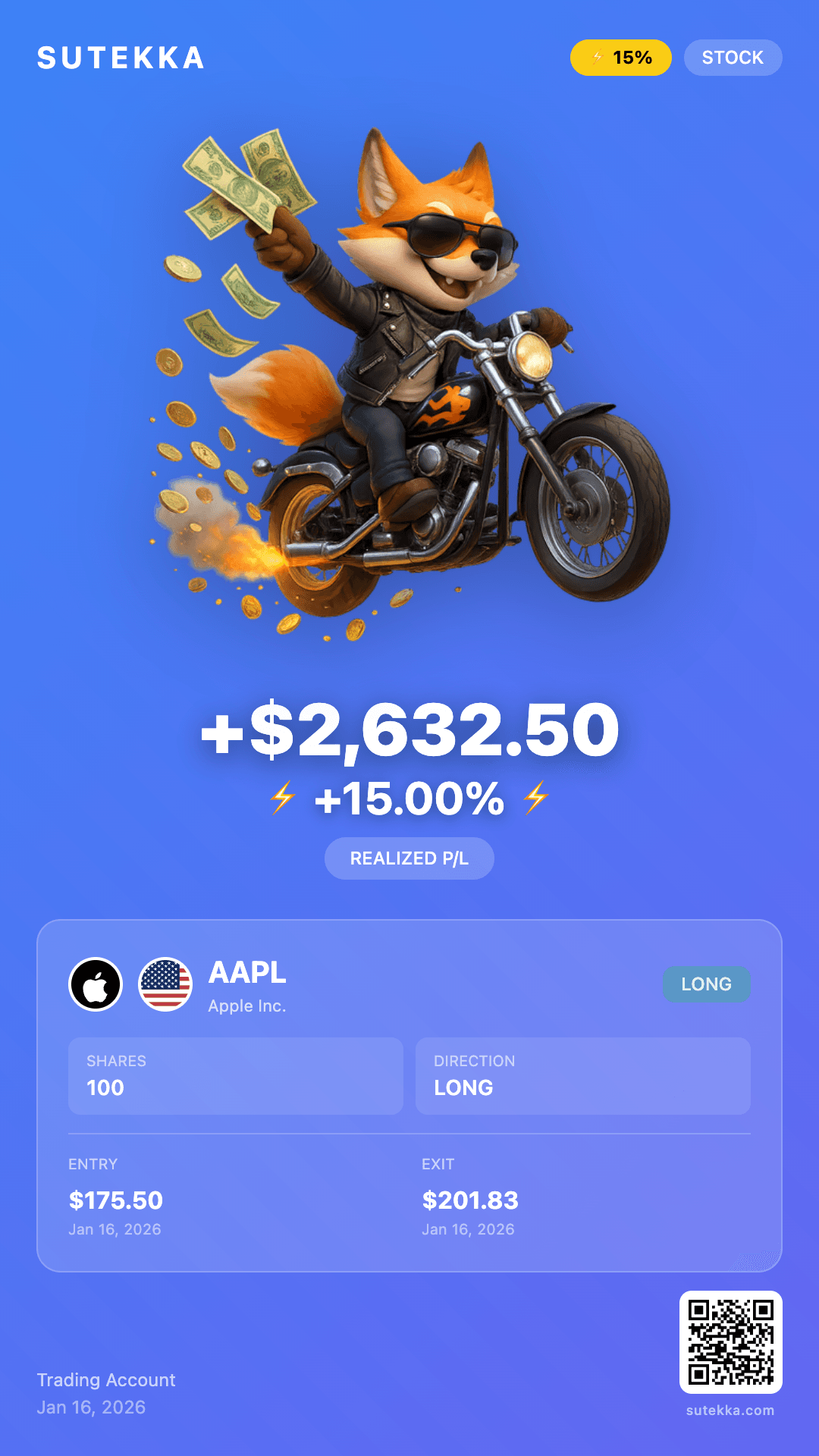
ALSO USEFUL
HOW IT WORKS
Why results get measured in R
R is the unit of initial risk. If you entered at $50 with a stop at $48, then 1R is $2 per share, and every outcome on that trade can be expressed as a multiple of it. A clean stop-out is −1R. An exit at $55 is +2.5R.
The value of the unit is that it makes trades comparable across sizes and instruments. A $500 gain and a $5,000 gain are the same trade if you risked ten times as much on the second — dollars obscure that, R does not. It is the only way to look at a track record spanning years of changing account size and see the edge rather than the balance.
A worked example
Entry at $50, stop at $48, exit at $55. Initial risk is $2 per share, the realised move is $5, so the trade closed at +2.5R.
Whether that was 100 shares or 2,000 does not change the score. Log fifty trades this way and the average tells you something dollars cannot: a +0.4R average across fifty trades is a real, measurable edge regardless of what the account was worth at the time.
Where this calculator misleads you
R is anchored to the initial stop, so a moved stop corrupts the measurement. Widening a stop mid-trade to avoid being taken out shrinks the reported R-multiple of the eventual loss and flatters the record. If you move stops, R is measuring your discipline as much as your edge — arguably useful, but not what most people think they are recording.
It is also silent about frequency and duration. A +2R trade held for three months and a +2R trade held for twenty minutes score identically, despite completely different returns on capital and time. R measures the quality of individual trades, not the productivity of a strategy.
Scaled entries and partial exits complicate the arithmetic further, since there is no single entry price or single risk figure. Pick a convention — most traders use the initial risk of the full intended position — and apply it consistently, because switching conventions mid-record makes the average meaningless.
Terms on this page
FAQ
What is an R-multiple?
Why use R instead of dollars?
What's a "good" average R-multiple?
Done with the math?
Now log the trade.
Sutekka is the journal that tracks every trade you take. Free forever — no card.
Start logging — free