Trade this for real? Sutekka turns it into this →
Auto-pulled from your broker, rendered as a card you can drop into Discord, X, or your group chat. Free forever — no card.
Try the journal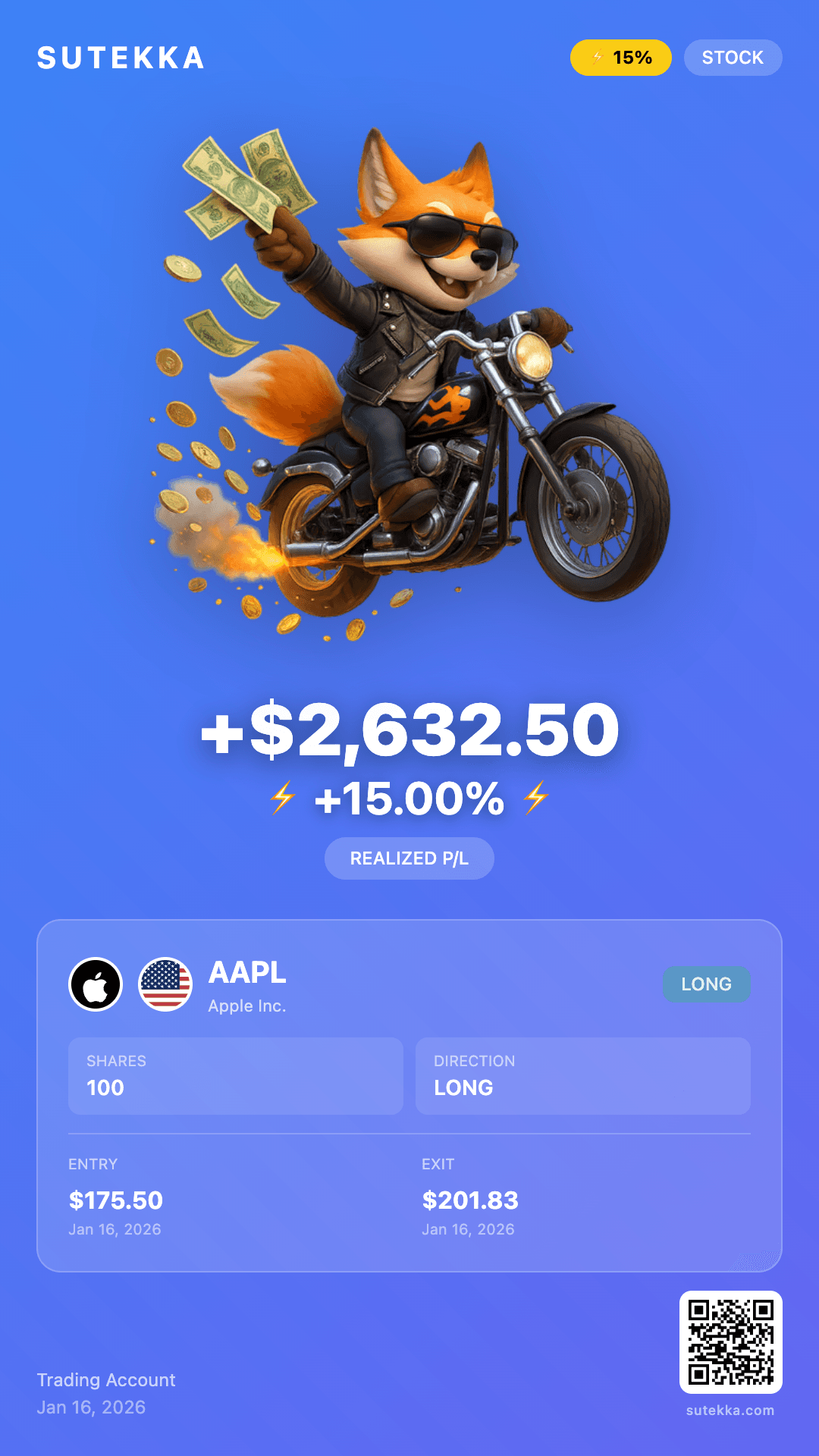
ALSO USEFUL
HOW IT WORKS
How target P&L is calculated
Profit from a target is a three-term product: the price move, the size, and the contract multiplier. The move and size are obvious; the multiplier is where most manual errors live. Stocks and crypto use a multiplier of 1, so the arithmetic is intuitive. Options apply ×100 because a contract controls a hundred shares. Futures use a per-contract point value that differs by product.
Direction flips the sign rather than the formula. A short earns (entry − target) instead of (target − entry), and everything downstream is unchanged. Fees come off the end, which matters more than it looks on high-frequency or small-size trades where commission is a real fraction of the edge.
A worked example
Two ES contracts entered at 5,000 with a target of 5,020. The move is 20 points, ES carries a $50 point value, and size is 2 — so (5,020 − 5,000) × 2 × $50 = $2,000 before fees.
The same 20-point move on a single MES contract, at $5 per point, is $100. Identical chart, identical thesis, twentieth of the outcome. Contract selection, not analysis, drives the difference — which is exactly why the multiplier deserves more attention than it usually gets.
Where this calculator misleads you
The return percentage is measured against notional, not against the margin you actually posted. For futures that distinction is enormous: $2,000 on $250,000 of notional reads as 0.8%, while the same trade against a few thousand dollars of day-margin is a far larger swing in account terms. On leveraged products the dollar figure is the honest one.
For options, the ×100 multiplier is right but the price path is not linear. An options position does not travel from entry to target the way a stock does — time decay and volatility changes move the premium independently of the underlying. Treat an options target as a rough estimate unless you are modelling the greeks separately.
And a target is a hypothesis, not a plan. The calculator will happily price a target you have no realistic prospect of reaching. Sanity-check the distance against recent range or ATR before trusting the number.
Terms on this page
FAQ
Does this work for options and futures?
How is P&L calculated?
Is the return percentage measured on margin?
Done with the math?
Now log the trade.
Sutekka is the journal that tracks every trade you take. Free forever — no card.
Start logging — free